
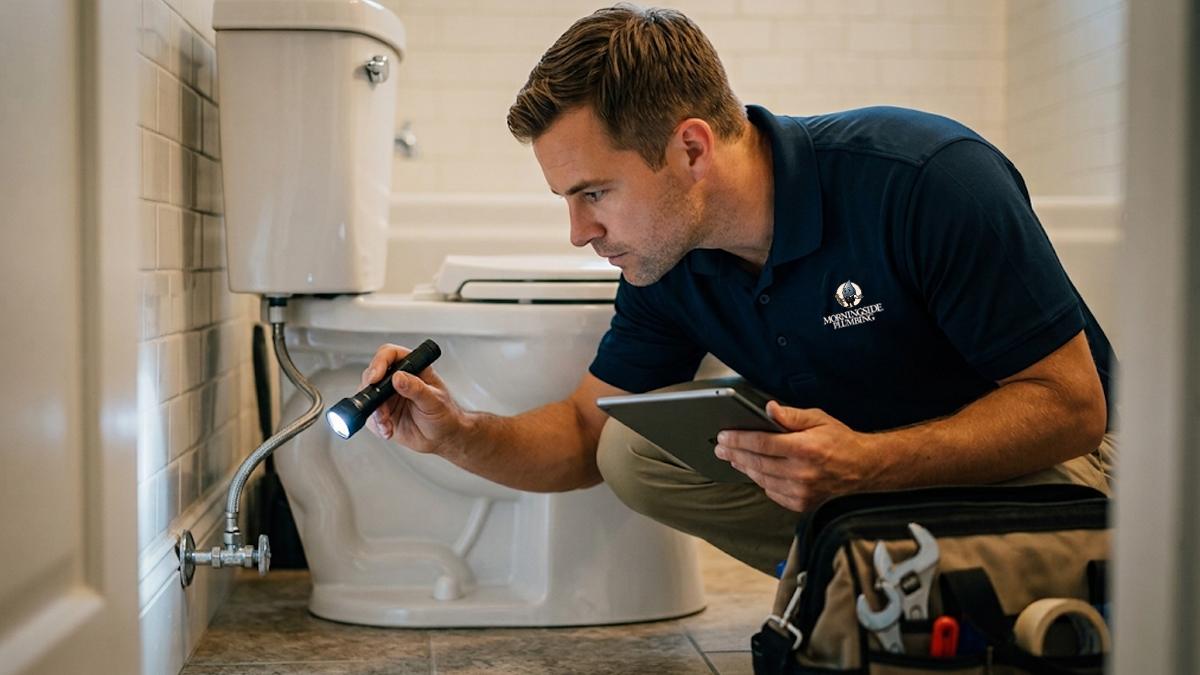
Most homeowners know where their circuit breaker is. Most know when their roof was last inspected. Very few know the condition of their pressure reducing valve, the state of their water heater's anode rod, or whether their sewer lateral has early-stage root intrusion working through a hairline crack. That's where a preventative plumbing maintenance plan comes in.
That gap between what homeowners know and what's actually happening inside their plumbing systems is where expensive problems are born.
The conventional approach to residential plumbing is reactive: leave the system alone until something fails, then call for emergency repairs. It's understandable. Plumbing is largely invisible, largely quiet, and largely problem-free for long stretches. But it's also the most expensive way to maintain a home's infrastructure, particularly for the older, architecturally significant properties that define Atlanta's most desirable intown neighborhoods.
This isn't a case for anxiety. It's a case for information.
The Economics of Reactive Versus Proactive Maintenance
Industry data from the Insurance Information Institute consistently shows that water damage and freezing account for roughly 24 to 27 percent of all residential property insurance claims filed annually in the United States. Second only to wind and hail damage. The average payout per water damage claim runs between $12,500 and $17,000, with recent data from the 2026 LexisNexis U.S. Home Trends Report showing claim severity rising more than 63 percent between 2019 and 2025, driven by post-pandemic construction material costs and rising labor rates for structural remediation.
Those numbers don't represent catastrophic flooding events. They represent supply line failures, water heater ruptures, sewer backups, and the slow-leak scenarios that compound undetected over weeks or months. Roughly one in every 50 to 60 insured homes files a water damage claim in a given year.
What makes that statistic particularly relevant for homeowners in neighborhoods like Midtown, Virginia-Highland, Ansley Park, Buckhead, Inman Park, and Chastain Park is the age of the housing stock. The plumbing systems serving Atlanta's historic intown neighborhoods weren't installed yesterday. Many were installed across multiple decades, with original galvanized supply lines connecting to copper additions from later renovations, and clay tile or cast iron sewer laterals that have been in the ground for 60 to 80 years. These systems don't fail dramatically. They degrade gradually, along timelines that reactive maintenance never catches until the degradation becomes a crisis.
Standard homeowner insurance policies carry deductibles of $1,000 to $2,500. More importantly, standard policy language frequently excludes water damage resulting from "continuous, repeated, or gradual seepage" — the precise failure profile of a slow-leaking drain, a pinhole pipe leak, or a decaying toilet seal. If an insurance adjuster determines that a leak existed for weeks before it was addressed, the claim may be denied entirely. And filing a single water claim can increase annual premiums by 15 to 30 percent for three to five consecutive years.
The financial case for proactive maintenance isn't abstract. It's actuarial.
Three Components That Fail Quietly
Understanding why plumbing maintenance matters requires understanding the specific failure modes that catch homeowners off guard. Three deserve particular attention.
The Pressure Reducing Valve
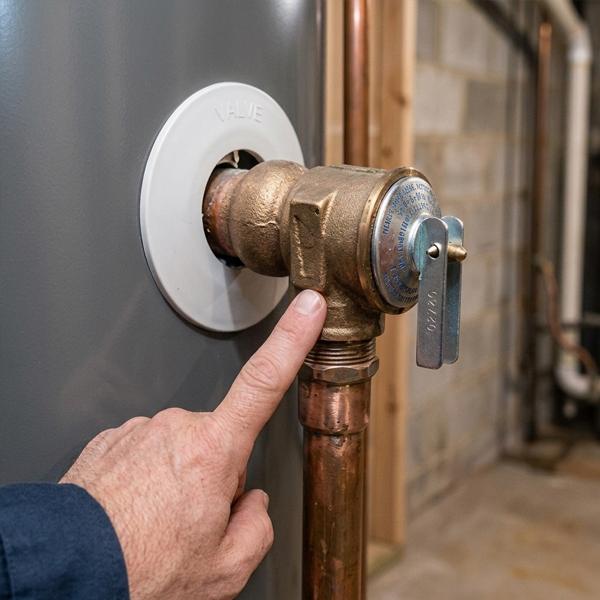 Municipal water systems operate at pressures between 90 and 150 pounds per square inch to maintain commercial fire-flow volumes throughout the distribution network. Residential plumbing and appliances are engineered to operate between 50 and 70 psi, with 80 psi representing the upper limit codified in the Uniform Plumbing Code. The pressure reducing valve (PRV) is the device that bridges these two realities, regulating incoming municipal pressure down to the safe operating range.
Over five to ten years of continuous operation, the elastomeric diaphragms, springs, and internal orifices inside a PRV degrade from friction and mineral deposits. When a PRV fails — and they do fail, typically without any visible warning — excessive municipal pressure enters the home's plumbing system.
The consequences ripple through every water-using appliance. Ceramic faucet cartridges wear prematurely. Toilet fill valves fail ahead of schedule. Washing machine solenoids are stressed. And critically, the water heater's thermal expansion balance is disrupted: if the PRV fails in a closed position while municipal pressure spikes, the resulting hydraulic pressure can deform the water heater tank or trigger the temperature and pressure relief valve, causing localized flooding.
PRV replacement typically runs $350 to $700 in parts and labor. An expense that prevents widespread premature fixture wear and potential water damage across the entire home. Most homeowners in established Atlanta neighborhoods — Druid Hills, Piedmont Heights, Morningside, Peachtree Hills — have never tested their PRV. Many don't know it exists. A failing PRV can be identified in a routine plumbing inspection before it triggers the cascade of fixture wear and appliance stress that follows undetected failure.
The Sacrificial Anode Rod
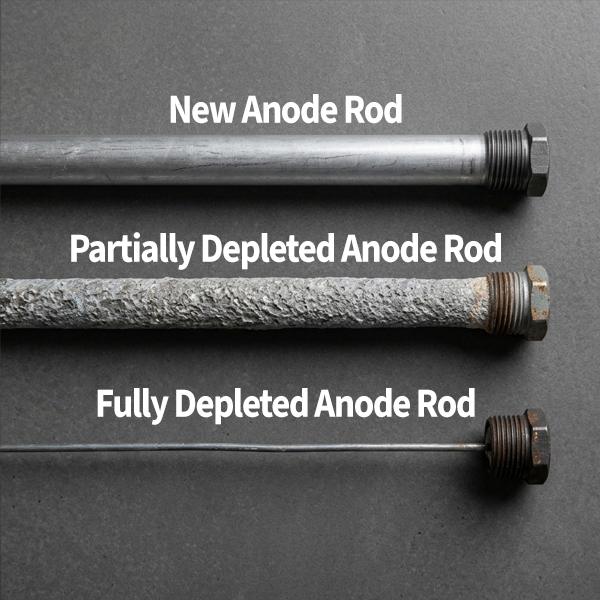 Every tank-type water heater contains a sacrificial anode rod: a magnesium, aluminum, or zinc alloy component designed to oxidize preferentially, drawing electrochemical corrosion away from the steel tank shell. It's a remarkable piece of passive engineering, and virtually no homeowner knows it exists.
Under typical domestic water conditions, anode rods are depleted within four to seven years. In hard water environments — or homes with water softeners that alter water chemistry — depletion can occur in as few as three years. Once the rod's core wire is exposed, electrochemical corrosion moves to the structural steel tank, forming pinhole leaks at welded seams within 18 to 24 months. A ruptured tank cannot be repaired. It requires full replacement.
Replacing a depleted anode rod during a routine inspection costs between $70 and $175 in parts and labor, and routinely extends tank lifespan from the baseline 8 to 10 year window to 15 years or more — deferring a full water heater replacement that typically runs $1,500 to $2,500 installed. Ignoring it until the tank fails costs the homeowner not just the replacement appliance, but any water damage that occurred during the failure — which, if the tank is in a mechanical room above finished living space, can be considerable. Water heater tank ruptures that occur while properties are unoccupied result in insurance claims averaging 49 percent higher than standard baseline losses, routinely exceeding $20,000 in structural damage.
The Sewer Lateral
 The sewer lateral — the pipe running from the home's foundation to the city connection — is the piece of infrastructure homeowners think about least and that causes some of the most expensive problems. Research published in peer-reviewed infrastructure journals, including a frequently cited review in the Journal of Infrastructure Systems, attributes more than 50 percent of sewer blockages globally to tree root intrusion. In Atlanta's intown neighborhoods, where mature oaks, magnolias, and sycamores have root systems that can travel 50 feet or more in search of moisture, this isn't a theoretical risk.
The progression is predictable. Fine root filaments enter through hairline cracks in aging clay tile or cast iron pipe. The interior of a sewer pipe — constant moisture, warmth, organic material — is an ideal environment. Those filaments expand into fibrous masses that progressively narrow the pipe's usable diameter. In Stage 1, the pipe is still largely functional but accumulating debris with every flush. In Stage 2, drains slow at every fixture throughout the house. In Stage 3, sewage stands in the lowest fixtures and backing up becomes routine.
A video camera inspection of the sewer lateral identifies root intrusion in its early stages — when a hydrojetting service can resolve it — rather than at Stage 3, when the conversation shifts to full sewer line replacement. Sewer backup and lateral line failure carries an average unmitigated financial exposure of $3,500 to $8,000 in blackwater extraction, line clearing, and drywall repair. For homeowners in Inman Park, Candler Park, Virginia-Highland, and Ansley Park, where century-old trees line streets and lots, early detection isn't just financially prudent. It's the difference between a maintenance call and a construction project.
What Professional Maintenance Actually Catches
The EPA's WaterSense program estimates that the average American household loses between 9,000 and 10,000 gallons of water annually to undetected leaks — dripping faucets, running toilets, compromised supply line connections. A single toilet flapper worn by mineral deposits or chloramines can silently lose 200 gallons per day, adding hundreds of dollars annually to combined water and sewer bills. A faucet dripping at one drop per second wastes more than 3,000 gallons per year.
These losses are detectable in a thorough plumbing inspection: dye testing for toilet seals, supply line integrity assessments, isolation checks at water meters. They're not detectable on a monthly water bill until the loss has been compounding for months.
A professional inspection also covers components that homeowners have no practical way to assess on their own: water pressure at the meter versus pressure at fixtures (which can reveal pipe scaling or PRV degradation), T&P valve operation on the water heater, washing machine hose condition, sump pump function, drainage velocity across the full fixture load, and cleanout accessibility for emergency response.
For homes with tankless water heaters — increasingly common in the renovated properties of Buckhead, Chastain Park, and Midtown's Garden District — professional maintenance is not optional in any practical sense. Mineral scale accumulates in the narrow passages of tankless heat exchangers at a rate that depends on local water hardness. Research from the Water Quality Research Foundation and the Battelle Memorial Institute demonstrates that a scale accumulation of just 1/8 inch reduces heat transfer efficiency by up to 25 percent. At 1/4 inch, efficiency losses reach 40 percent or more. In high-hardness water environments, unmaintained tankless systems can suffer heat exchanger blockage and thermal failure in as few as two years. Most tankless manufacturers require documented proof of annual professional descaling as a condition for warranty approval on replacement parts — without that documentation, a warranty on a multi-thousand-dollar appliance becomes unenforceable.
The Older Home Variable
The financial return on proactive plumbing maintenance scales with the age and complexity of the home. For properties built within the last five years with modern PEX piping, code-compliant PRVs, and builder warranties still active, the economic case is more modest.
For homes 15 years old or older — the overwhelming majority of the housing stock in Atlanta's intown neighborhoods — the calculus changes substantially. Industry analysis suggests these homes can realize direct annual savings of $350 to $800 through averted premature component failure, leak reduction, and discounted routine repairs, against membership costs that represent a fraction of a single emergency service call. These are properties with original or near-original plumbing components approaching their design lifespans. Original PRVs. Anode rods that may never have been inspected. Sewer laterals that have been accumulating decades of root exposure.
The homes in Morningside, Virginia-Highland, Ansley Park, Inman Park, and the surrounding neighborhoods were built to last. They've lasted. That same longevity applies to their plumbing systems — and to the failure modes those systems have been developing quietly for decades.
Proactive Care as Property Stewardship
 Atlanta's intown neighborhoods attract homeowners who understand that maintaining a historic property requires a different standard of care than maintaining a tract house. These are people who restore original hardwood floors rather than carpet over them, who preserve original millwork rather than replace it, who understand that what makes these homes valuable is precisely what makes them irreplaceable.
The same principle applies underground. The plumbing systems beneath these homes don't announce their condition. They work quietly, degrade quietly, and fail — when they fail — expensively and without warning. Proactive inspection and maintenance is how homeowners who care about these properties stay ahead of that curve.
The Morningside Care Club was designed for exactly this kind of homeowner. Inspections cover the full scope of what matters: PRV condition and pressure testing, water heater safety and efficiency assessment including anode rod verification, sewer lateral evaluation, supply line integrity, fixture performance, and drainage velocity. When a developing issue is identified, the homeowner has time to plan and budget — not a Sunday night emergency with a flooded basement.
Morningside Plumbing has served Atlanta's intown neighborhoods for more than 50 years. The homes in Morningside, Lenox Park, Virginia-Highland, Ansley Park, Inman Park, Midtown, Buckhead, Druid Hills, Chastain Park, Candler Park, Poncey-Highland, and the surrounding communities are the properties we know best — and the ones where the difference between proactive and reactive maintenance is most consequential.
If you'd like to understand the condition of your home's plumbing systems, a professional inspection is the right place to start. Call 404.873.1881 or schedule online.